
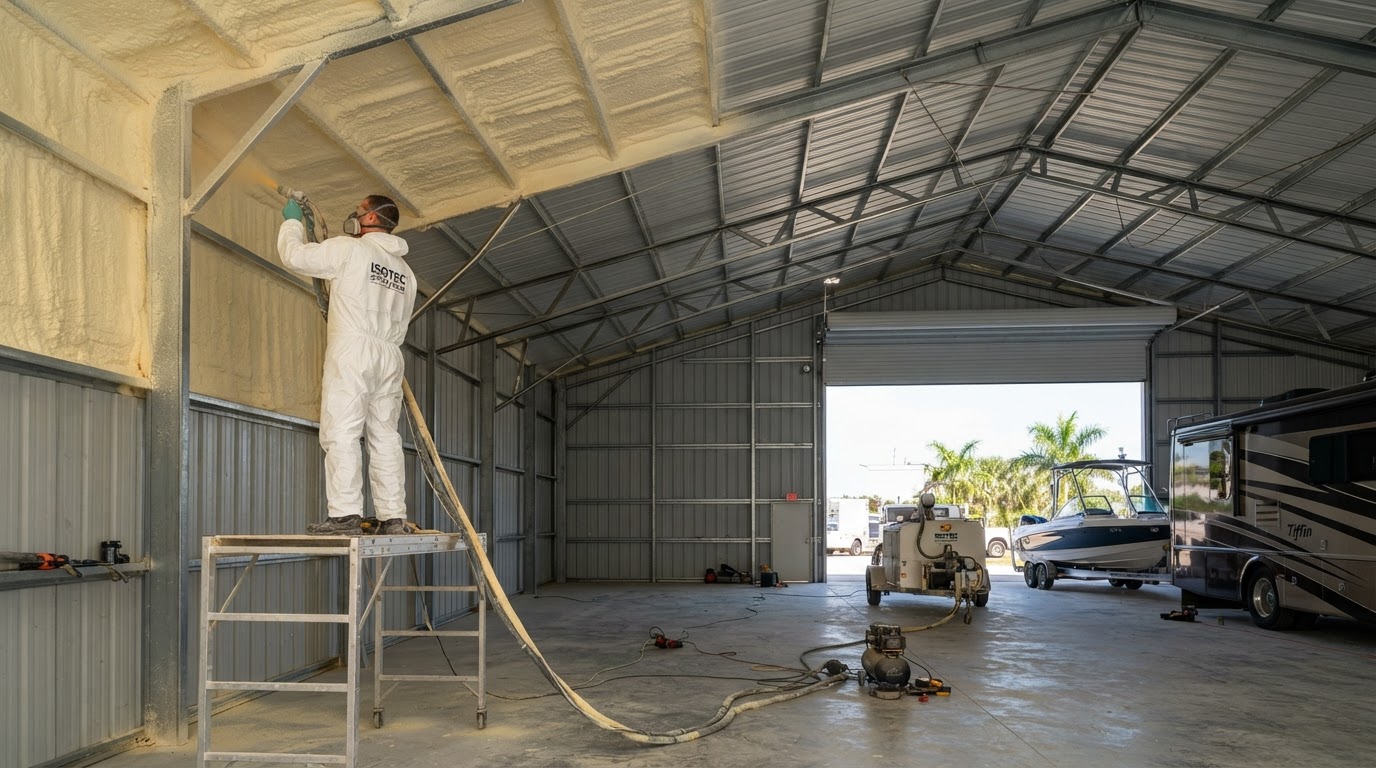
Boat & RV Storage Building Spray Foam Insulation in Cape Coral, FL
Spray foam insulation for Cape Coral boat storage buildings, RV garages, and large metal vehicle storage structures. We evaluate tall walls, large roof areas, and conditioned storage goals to recommend the right approach.
Why Spray Foam Is Considered for Boat & RV Storage Buildings
Direct Answer: Boat and RV storage buildings are large-volume metal structures with tall walls and expansive roofs that absorb solar heat and allow air leakage. Spray foam is considered for these buildings because it adheres to steel panels, helps reduce radiant heat transfer and uncontrolled air movement, and supports a continuous thermal envelope across conditioned storage or workshop areas when properly specified.
A storage building's metal roof and tall walls face intense Southwest Florida solar radiation, transferring heat into the interior. For a conditioned storage space or an attached workshop, that heat gain increases the load on cooling and dehumidification equipment. Large door openings for vehicles and boats also contribute to uncontrolled air infiltration.
Spray foam conforms to corrugated metal profiles and seals around penetrations, helping reduce both radiant heat transfer and air leakage. We do not guarantee preservation of vehicles, boats, electronics, finishes, or stored belongings, since interior conditions also depend on HVAC, dehumidification, and ventilation systems that operate separately from the insulation.
Types of Vehicle Storage Buildings We Help Evaluate
RV Garages
Tall RV garages with large door openings and high roof areas.
Boat Storage Buildings
Boat barns and enclosed storage structures for watercraft.
Metal Storage Buildings
Large metal storage buildings with conditioned zones.
Large Detached Garages
Oversized detached garages for vehicles and equipment.
Workshop-Storage Combos
Combined workshop and storage facilities with varied conditioning.
Enclosed Equipment Buildings
Enclosed buildings for equipment and vehicle protection.
Open Cell vs. Closed Cell for Storage Buildings
Because these structures are predominantly metal, foam selection leans toward closed-cell characteristics, while product choice remains project-specific.
Closed Cell for Metal
Closed cell is often considered for metal storage buildings because of its density, moisture resistance, and adhesion to steel. It suits tall wall panels and large roof areas where its vapor characteristics support the assembly's moisture strategy.
Closed cell detailsOpen Cell Considerations
Open cell may suit framed interior partitions or deep cavities within a storage building where sound absorption is a consideration. Its vapor permeability means the overall assembly and moisture strategy must be evaluated before selection.
Open cell detailsStorage Building Spray Foam Installation & Cost Factors
Review whether storage is conditioned and what is stored.
Inspect tall walls, roof, height, access, and substrate.
Determine surfaces, foam type, thickness, and lift access.
Mask vehicles, boats, equipment, and openings.
Spray foam in controlled passes using lift equipment where needed.
Verify coverage and adhesion across all surfaces.
What Affects Storage Building Cost
• Building dimensions
• Tall wall height
• Large roof area
• Lift access
• Foam thickness
• Metal substrate condition
• Vehicle and equipment protection
• Existing finishes
• Surface preparation
Boat & RV Storage Building FAQs
Direct answers for Cape Coral vehicle storage building owners.
Request a Boat & RV Storage Building Estimate
Own a vehicle storage building in Cape Coral? Discuss tall walls, large roof areas, and conditioned storage goals with our team.