
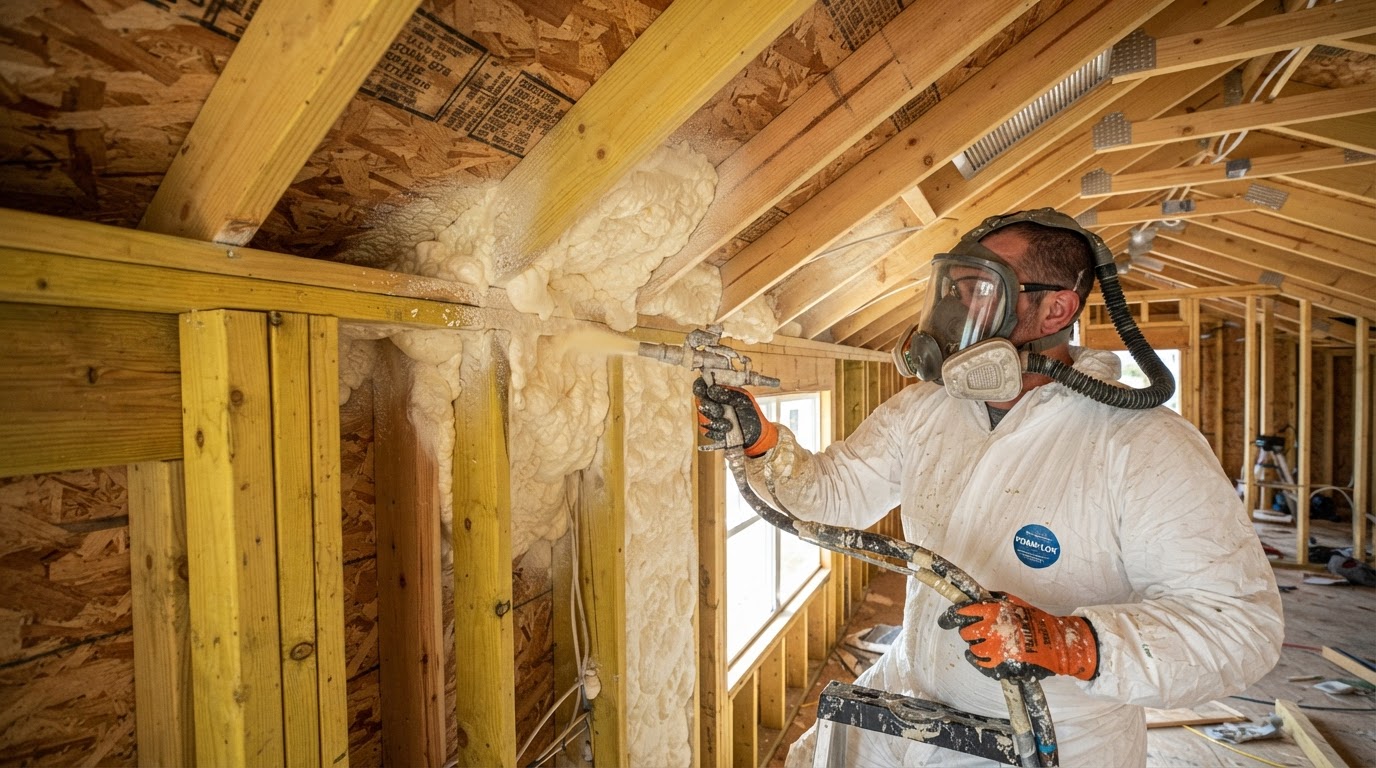
Wall, Ceiling & Roof Deck Spray Foam Insulation in Cape Coral, FL
Different building surfaces require different insulation strategies. Spray foam can be used across walls, ceilings, and roof decks when appropriately specified for each assembly.
Walls, Ceilings & Roof Decks in Cape Coral Properties
Direct Answer: Walls, ceilings, and roof decks each play a distinct role in the building envelope. Spray foam can be applied to these assemblies to form a continuous thermal boundary and air seal, but the correct product and depth depend on the specific surface, framing, and moisture strategy of each assembly.
Walls
Exterior walls separating conditioned from unconditioned space benefit from continuous air sealing around framing, wiring, and penetrations.
Ceilings
Cathedral and vaulted ceilings with limited rafter depth can use spray foam to seal the underside of the ceiling deck completely.
Roof Decks
Applying foam to the roof deck moves the thermal boundary to the roofline, helping reduce radiant heat transfer in Southwest Florida.
Attic spray foam detailsBuilding-Envelope Benefits Across Surfaces
In Florida's hot, humid climate, continuity across surfaces matters as much as the insulation itself.
Air Leakage Control
Foam seals around penetrations and irregular cavities to help reduce uncontrolled air infiltration.
Thermal Continuity
A continuous boundary across walls and roof decks supports consistent envelope performance.
Roof Deck Heat
Roof decks exposed to intense solar heat can benefit from a foam boundary at the roofline.
Conditioned Separation
Walls separating conditioned from unconditioned spaces gain a tighter, more continuous seal.
Open Cell vs. Closed Cell by Assembly
The correct foam depends on wall type, roof assembly, ceiling location, building use, thickness, and the project's moisture and vapor strategy.
Open Cell Applications
- • Deep roof rafters and attic roof decks
- • Framed wall cavities where vapor permeability aligns with design
- • Interior partitions where sound absorption may be relevant
Closed Cell Applications
- • Shallow 2x4 framing and masonry walls
- • Roof decks where moisture resistance or rigidity is desired
- • Assemblies requiring a vapor retarder at specified depths
We do not provide universal prescriptions. The appropriate product depends on the building assembly and project goals, and each surface should be evaluated individually.
Installation Considerations for Walls, Ceilings & Roof Decks
Open framing during construction or remodels allows complete coverage.
Rafter depth, stud spacing, and roof pitch influence product and depth.
Finished walls and ceilings may need to be opened to access cavities.
Old material may be removed or retained based on the evaluation.
Floors, openings, and mechanical/electrical penetrations are protected.
New construction offers full access; retrofits depend on available openings.
What Affects Cost
• Surface area and pitch
• Foam type and thickness
• Number of assemblies
• Access and existing finishes
• Existing insulation removal
• Framing geometry
Wall, Ceiling & Roof Deck Spray Foam FAQs
Direct answers about insulating multiple building surfaces.
Request a Wall, Ceiling & Roof Deck Estimate
Contact our Cape Coral team to discuss spray foam across multiple building assemblies and the right product for each surface.