Commercial & Industrial Spray Foam Insulation in Cape Coral, FL
Continuous thermal-envelope and air-sealing solutions for Cape Coral commercial buildings, warehouses, offices, and light industrial structures. We evaluate each property individually and recommend the right foam for the assembly.
Spray Foam Insulation for Cape Coral Commercial Buildings
Direct Answer: Commercial spray foam insulation is a site-applied polyurethane material that expands to fill wall cavities, roof decks, and metal assemblies, creating a continuous thermal barrier and air seal. For Cape Coral commercial buildings, it helps address radiant heat transfer, uncontrolled air leakage, and the long cooling-season demands common to Southwest Florida.
Commercial structures in Southwest Florida face sustained thermal pressure from intense sun, high humidity, and extended air-conditioning seasons. Large roof spans and metal wall panels can transfer significant heat into interior spaces, increasing the load on mechanical systems and affecting occupant comfort and equipment environments.
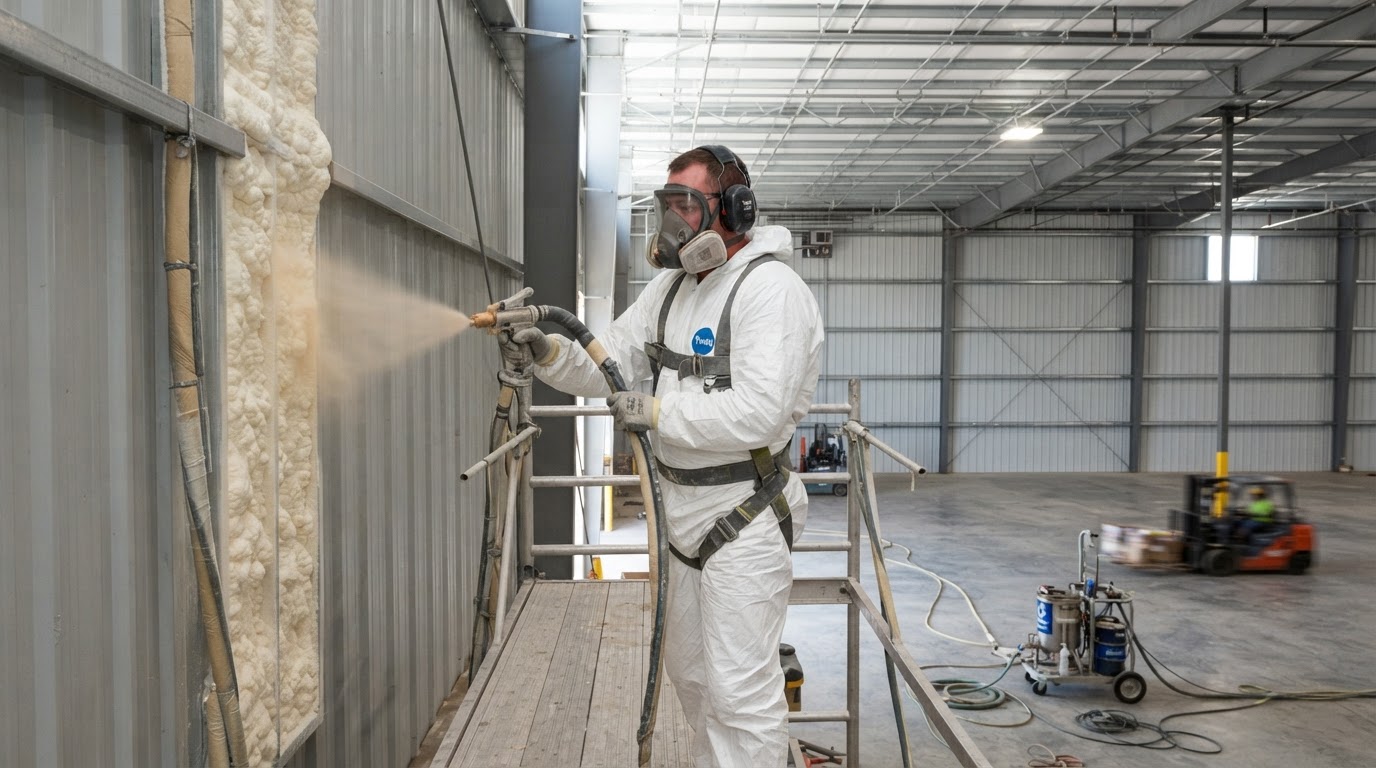
Spray foam can be applied to commercial walls, roof decks, and metal assemblies to form a continuous boundary that helps reduce uncontrolled air leakage and supports thermal-envelope performance. Because every commercial building differs in construction, use, and mechanical design, each property should be evaluated individually before a foam strategy is recommended.
Where Commercial Spray Foam Works in Cape Coral
From office build-outs to metal warehouses, spray foam adapts to a range of commercial assemblies when appropriately specified.
Offices & Retail
Wall and ceiling assemblies in office and retail spaces can benefit from continuous air sealing and thermal resistance for occupant comfort.
Warehouses & Storage
Metal and framed warehouses can use spray foam on roof decks and walls to help moderate interior temperatures and protect stored goods.
Light Industrial
Light industrial buildings and utility spaces may benefit from a tighter envelope where conditioned interiors are desired for equipment or personnel.
Potential Building-Envelope Benefits
A continuous foam barrier can help reduce uncontrolled air infiltration through commercial walls and roof assemblies.
Spray foam conforms around irregular cavities and penetrations to support a more continuous thermal boundary.
Conditioned commercial spaces may benefit from more stable interior temperatures when the envelope performs effectively.
Choosing the Right Foam for a Commercial Assembly
The appropriate foam depends on the assembly, substrate, interior or exterior position, desired characteristics, thickness, and the project's moisture and vapor strategy.
Open Cell Considerations
Open cell foam's high expansion can fill deep framed cavities economically and may offer sound-absorption characteristics. It is generally vapor permeable, so it is best suited to assemblies where that behavior aligns with the building-envelope design.
Open cell detailsClosed Cell Considerations
Closed cell foam offers higher thermal resistance per inch and acts as a vapor retarder at specified depths. It is commonly selected for metal buildings, shallow cavities, and assemblies where moisture resistance or rigidity is beneficial.
Closed cell detailsWood framing, concrete masonry, and steel panels each influence foam selection and surface preparation.
Interior vs exterior placement affects vapor strategy and which foam chemistry is appropriate.
Required thermal resistance and cavity depth help determine product and application depth.
Applicable building requirements and the building's intended use guide the overall envelope plan.
Commercial Spray Foam Installation Near Cape Coral
A structured process helps ensure each commercial property receives an application-specific approach.
We review building use, goals, and the areas under consideration for insulation.
We inspect substrates, access, height, and existing materials to scope the work.
We recommend foam type, thickness, and target assemblies based on the evaluation.
Floors, equipment, openings, and sensitive areas are protected before application.
Foam is applied in controlled passes to the specified assemblies and depths.
Finished areas are reviewed with the property stakeholder before project closeout.
What Affects Commercial Cost
• Building size and height
• Access and equipment needs
• Foam type and thickness
• Number of surfaces insulated
• Existing materials and removal
• Project phasing and scheduling
We provide estimates based on your specific property and application rather than generic pricing.
Commercial Spray Foam FAQs
Direct answers for Cape Coral commercial property stakeholders.
Request a Commercial Spray Foam Estimate
Contact our Cape Coral team to discuss thermal-envelope and air-sealing solutions for your commercial or industrial building.