Spray Foam for Metal Building Condensation Control in Cape Coral, FL
Spray foam insulation to help manage condensation on Cape Coral metal building roofs and walls. We evaluate surface temperature, humidity, ventilation, and the overall assembly to recommend a careful, building-specific approach.
Why Cape Coral Metal Buildings “Sweat”
Direct Answer: Metal buildings sweat when warm, moisture-containing interior air reaches a cooler metal surface and condenses into water droplets. In humid Southwest Florida, the temperature difference between interior air and an uninsulated metal roof or wall panel can be large enough to produce condensation, especially when interior humidity is high or ventilation is inadequate.
Condensation depends on surface temperature, interior humidity, outdoor conditions, ventilation, HVAC, air movement, building use, thermal bridging, and the roof and wall assembly. An uninsulated metal panel can cool below the dew point of the surrounding air, causing moisture to collect on its surface.
Interior moisture generation from processes, equipment, or stored materials can raise humidity further. Without insulation or humidity control, the metal surface remains a likely condensation point. We never promise that spray foam eliminates all condensation, since the full set of conditions must be addressed together.
How Appropriately Specified Spray Foam Can Help
Insulates Metal Surfaces
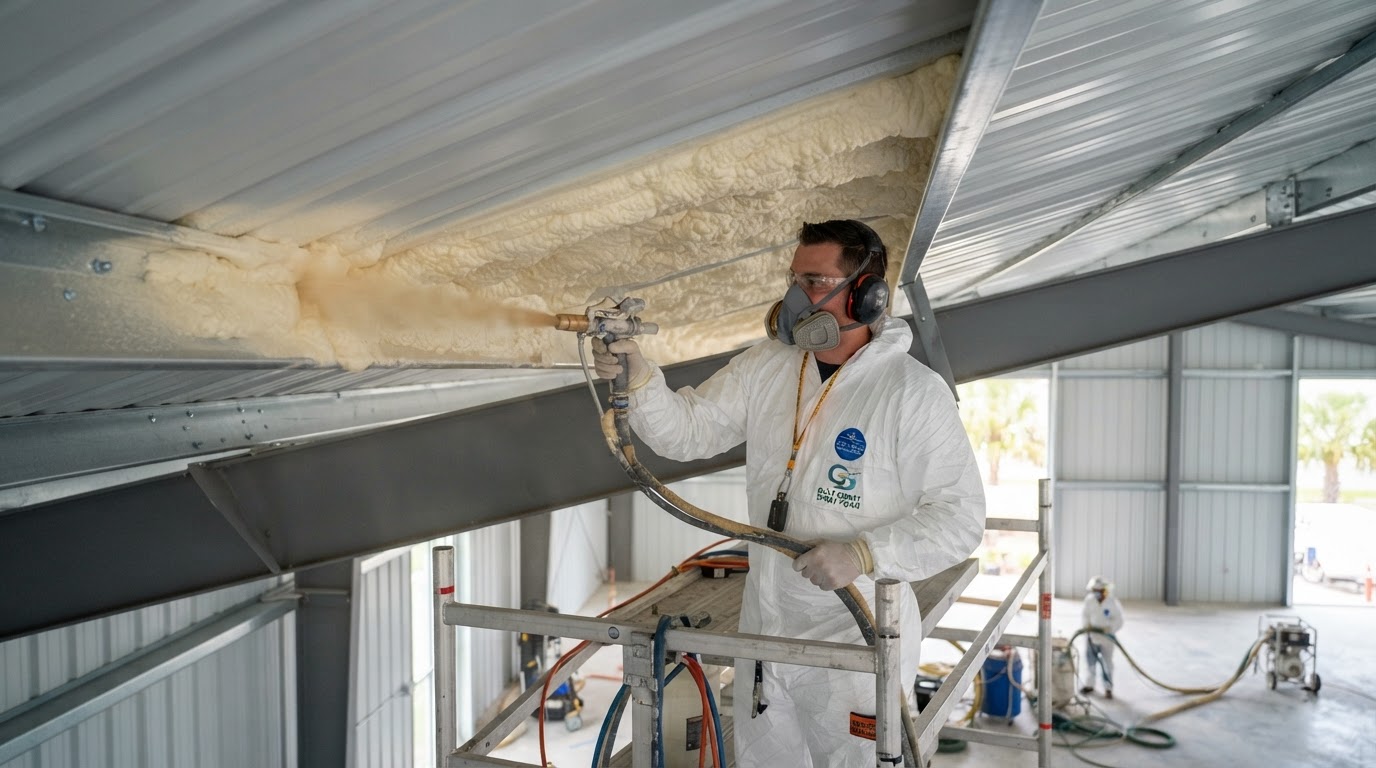
Adds insulation directly against suitable metal surfaces to moderate surface temperature.
Reduces Air Contact
Helps reduce interior air contact with cold metal surfaces that cause condensation.
Improves Thermal Continuity
Supports a more continuous thermal envelope across roof and wall assemblies.
Reduces Air Movement
Helps reduce uncontrolled air movement that carries moisture into the assembly.
We use “can help” and “may reduce risk.” Spray foam does not guarantee complete elimination of condensation, since ventilation, humidity, and the overall assembly must be considered together.
Closed Cell Foam & Building-Science Considerations
Closed cell foam is often considered for metal surfaces, while the overall moisture strategy must address the full set of conditions that produce condensation.
Metal must be clean, dry, and free of corrosion for proper adhesion.
Significant corrosion must be evaluated before any application.
Active leaks must be repaired separately before insulation.
Ventilation remains part of the overall moisture strategy.
Interior humidity and HVAC influence condensation risk.
How the building is used affects interior moisture generation.
Active roof leaks must be repaired separately. We do not advise spraying over wet surfaces, active leaks, or significant corrosion without evaluation.
Condensation-Control Assessment & Cost Factors
Review how the building is used and interior moisture sources.
Evaluate the existing condensation pattern and affected surfaces.
Check for active leaks, corrosion, and existing coatings.
Select foam type, thickness, and target surfaces.
Clean metal and address repairs before application.
Install foam and verify coverage and adhesion.
What Affects Condensation-Control Cost
• Building use
• Existing condensation pattern
• Roof and wall dimensions
• Foam thickness
• Surface preparation
• Height and access
• Existing equipment
• Roof condition
• Existing coatings
Metal Building Condensation Control FAQs
Direct answers for Cape Coral metal building owners dealing with sweating roofs.
Discuss Your Metal Building Condensation Concerns
Dealing with a sweating metal roof in Cape Coral? Request an evaluation of surface temperature, humidity, and assembly conditions.